
HiLetgo 3pcs ESP8266
4.2Editor score
Low Cost Entry
AP STA Modes
Arduino Compatible
This guide compares the top 10 Arduino WiFi Module options for IoT projects, covering connectivity, performance, and ease of use for makers.
Selecting the right wireless connectivity solution is crucial for modern embedded projects. An Arduino WiFi Module enables seamless internet access, allowing sensors and controllers to communicate globally without complex wiring setups.
We evaluated ten distinct options based on community feedback, technical specifications, and integration capabilities. Our analysis focuses on stability, processing power, and compatibility with the Arduino ecosystem to help you choose wisely.
Each pick highlights specific strengths for different project types, from budget sensors to advanced industrial systems. Please note that availability and stock levels can shift rapidly due to high demand in the maker community.
4.2Editor score

4.7Editor score

4.5Editor score
The following table provides a side-by-side technical overview of all ten selected modules to help you compare key specifications and features efficiently.



The Arduino UNO R4 WiFi stands out as the most capable platform on this list. With a 4.7 rating from users, it delivers exceptional performance for complex IoT applications that require both processing power and connectivity.
We may earn a commission when you buy through this link, at no additional cost to you.
Its dual-core design combines a Renesas RA4M1 microcontroller with an ESP32-S3 chip. This allows you to run heavy logic tasks on one core while handling wireless communication on the other without lag. The inclusion of CAN bus support makes it uniquely suited for automotive or industrial robotics where reliability is non-negotiable.
While the features are impressive, the board can be overwhelming for those new to electronics. The advanced capabilities like OP-AMP and DAC are often unused in simple hobbyist projects. However, for users needing precision control, these trade-offs are negligible compared to the flexibility offered.
This board is the clear choice for advanced makers and professionals building robust systems. If you need a single solution that handles sensing, communication, and visual feedback without external add-ons, this is the definitive option available today.
The CAN bus support allows this board to communicate directly with automotive systems and industrial controllers without needing extra bridges.
The onboard 12×8 LED matrix lets you display status information or text directly on the board, removing the need for external screens.
We may earn a commission when you buy through this link, at no additional cost to you.
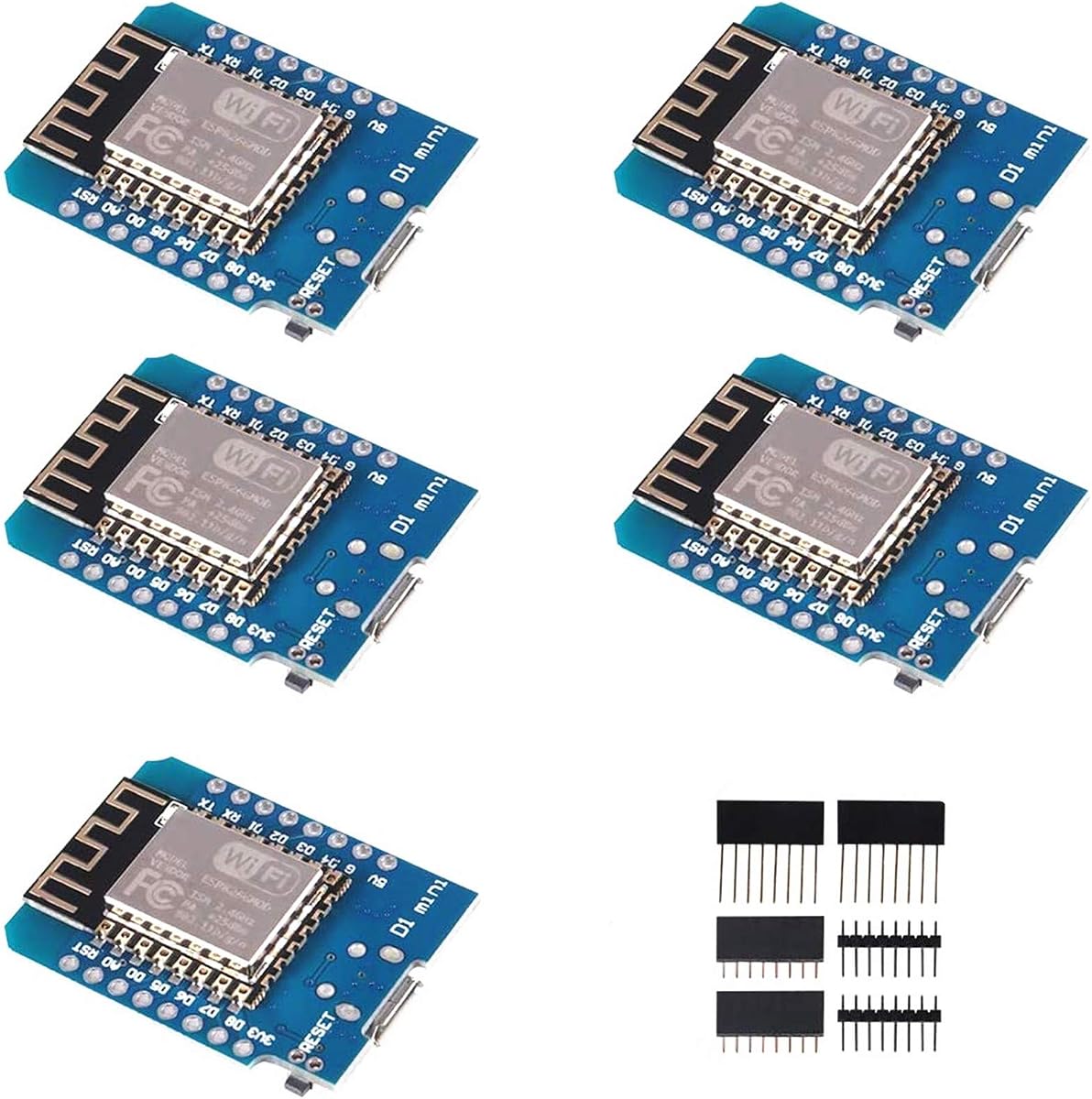
For makers working with tight budgets, the HiLetgo 3pcs ESP8266 pack offers incredible value. Despite a slightly lower rating of 4.2, it remains a staple for hobbyists who need basic Wi-Fi connectivity without spending much.
We may earn a commission when you buy through this link, at no additional cost to you.
Each module in this pack features the powerful ESP8266 chip, which supports both Access Point and Station modes. This flexibility allows you to create direct connections between devices or link to existing networks. The LWIP stack included ensures efficient TCP/IP handling.
The main limitation is that this module does not include a USB-to-serial adapter, requiring you to use an external programmer. Additionally, it operates strictly on 3.3V logic, so you must use level shifters when connecting to 5V Arduinos.
If you are building multiple small sensor nodes or prototypes where cost is the primary driver, this is the ideal starting point. It provides the essential Wi-Fi functionality needed for basic smart home or monitoring projects.
Getting three modules in a single pack means you can start multiple projects simultaneously without needing to buy more later.
Support for AP, STA, and AP+STA modes allows you to configure the device as a client or a hotspot depending on your network needs.
We may earn a commission when you buy through this link, at no additional cost to you.
The ESP8266 ESP-01S is a refined version of the classic module that addresses many community feedback points. It holds a strong 4.4 rating due to its reliability and the extra flash memory included for more complex sketches.
We may earn a commission when you buy through this link, at no additional cost to you.
With 4MB of flash, you can store larger programs and data logs directly on the module without relying on external storage. The signal strength is notably improved over older variants, ensuring better connectivity in areas with weaker Wi-Fi signals.
Installation requires soldering header pins, which can be a barrier for absolute beginners. Additionally, the pins are quite close together and limited in number, meaning you cannot directly attach large shields without breaking out the signals to a breadboard.
This module is excellent for users who want a standalone wireless solution or need to integrate Wi-Fi into small custom boards. It balances size and performance well, making it a favorite for wearable electronics or compact sensor units.
The 4MB flash allows for storing larger code and local data, reducing the need for external storage chips in your project.
Upgraded antenna capabilities provide a stronger and more stable connection compared to earlier ESP-01 versions found in older stock.
We may earn a commission when you buy through this link, at no additional cost to you.
For those needing to stock up on wireless modules, the Aitrip 5pcs pack offers a reliable solution. With a 4.4 rating, it appeals to users who prioritize quantity and consistent performance for classroom or mass deployment scenarios.
We may earn a commission when you buy through this link, at no additional cost to you.
These modules operate on a voltage range between 3.0V and 3.6V, which is slightly more forgiving than some strict 3.3V only versions. They come ready to use with AT commands, allowing you to quickly test functionality before integrating them into a design.
The 1MB flash memory is sufficient for standard connectivity tasks but may limit you if you plan to store heavy data locally. Also, care must be taken to ensure your power supply is stable within the specified voltage range to avoid damage.
If you are building a large sensor network or running a workshop where modules may be lost or swapped, this bulk pack is an excellent investment. It provides a cost-effective way to equip many different nodes without compromising on core quality.
Having five modules ready to use streamlines the process of setting up multi-node systems like distributed temperature sensors.
These modules can be controlled via simple AT commands, allowing you to test connections quickly before writing complex Arduino code.
We may earn a commission when you buy through this link, at no additional cost to you.
ELEGOO provides a robust alternative to standard Arduino boards with this pack of ESP-32 dev boards. Rated at 4.7 by users, these boards are known for their high speed and ability to handle complex multitasking requirements seamlessly.
We may earn a commission when you buy through this link, at no additional cost to you.
The ESP32 chip runs at up to 240 MHz on two cores, which is significantly faster than many other options on this list. It also includes built-in Bluetooth 4.2, allowing you to connect to phones or wearables alongside Wi-Fi networks.
Programming is handled via USB-C, which is more durable than older standards, though the cable is not included in the box. You may also need to install specific board definitions in the IDE to unlock full compatibility with all features.
This is the perfect choice for projects that demand high performance, such as video streaming, advanced data processing, or dual-protocol communication. If you need speed and flexibility without needing a full Arduino UNO form factor, these boards are ideal.
Dual-core architecture allows you to run sensor reading on one core while managing network connections on the other efficiently.
Having both Wi-Fi and Bluetooth onboard means you can support a wider range of devices without adding extra hardware components.
We may earn a commission when you buy through this link, at no additional cost to you.
The Arduino Nano ESP32 represents the next generation of affordable microcontrollers. With a 4.5 rating, it combines the small size of a Nano with the powerful capabilities of the ESP32-S3 series for modern IoT needs.
We may earn a commission when you buy through this link, at no additional cost to you.
Support for MicroPython is a major advantage for developers who prefer Python over C++. This lowers the barrier to entry and speeds up development cycles significantly. Additionally, native HID support allows the board to act as a keyboard or mouse directly.
It ships without headers, meaning you must solder them yourself or use a breadboard holder to connect it. This might be inconvenient for users who want plug-and-play convenience, but it keeps the price lower for bulk orders.
If you value software flexibility and modern connectivity standards, this board is unmatched. It is particularly well-suited for educational settings, rapid prototyping, or creating custom input devices using existing Arduino IDE tools.
MicroPython compatibility lets you write scripts in Python, which is often faster and easier to read than traditional Arduino C code.
HID support means you can build custom keyboards or mice without needing extra microcontrollers or complex firmware hacks.
We may earn a commission when you buy through this link, at no additional cost to you.
This pack of four modules offers a balance of quality and quantity for smaller projects. Users rate it at 4.4 for its reliability, noting that the modules are self-calibrated for optimal RF performance right out of the box.
We may earn a commission when you buy through this link, at no additional cost to you.
The self-calibration feature ensures that the radio frequency performance is tuned for the specific environment, reducing interference issues common with cheaper generic parts. The small form factor makes it easy to hide inside enclosures or wearables.
You will need to solder pins to connect these to a breadboard, which can be difficult if you are new to soldering. Additionally, like most 3.3V modules, they require careful power management to avoid voltage drops during transmission.
This is a solid option for hobbyists who need a few units for a home automation setup. The pack size is sufficient for most small projects without overwhelming you with too many parts you might not use.
Self-calibrated RF ensures consistent signal quality across all modules in the pack without requiring manual tuning.
The tiny size makes it ideal for wearable electronics where space inside a fabric casing is extremely limited.
We may earn a commission when you buy through this link, at no additional cost to you.
Rated at 4.5, this set of five modules provides a robust foundation for IoT development. The 4MB flash is a key differentiator that allows for larger code sizes and local data storage capabilities.
We may earn a commission when you buy through this link, at no additional cost to you.
Each module operates at a standard baud rate of 115200, which ensures compatibility with most serial debuggers. However, you must configure the SPI mode correctly in your IDE as DOUT to avoid programming errors during upload.
The strict 3.3V requirement means you cannot connect it directly to a 5V pin on an Arduino. You must use a logic converter to ensure your serial signals are not damaged. Failing to do so can permanently fry the module.
For developers who need to flash custom firmware or store certificates locally, this extra memory is highly valuable. It is also great for bulk projects where you need multiple nodes to store unique device identifiers.
The 4MB flash allows storing SSL certificates or large configuration files locally without needing external memory chips.
Having ample space means you can update firmware over the air with larger payloads without hitting storage limits.
We may earn a commission when you buy through this link, at no additional cost to you.
This product offers a complete development board rather than a bare module, rated at 4.5 for its ease of use. The NodeMcu D1 Mini format is beloved for its balance of size and feature richness for general IoT tasks.
We may earn a commission when you buy through this link, at no additional cost to you.
Unlike the ESP-01, this board has USB connectivity directly built in, allowing you to program it without extra adapters. It provides eleven digital pins, giving you plenty of room for sensors, LEDs, and other peripherals.
The onboard regulator handles power input from 5V to 3.3V, simplifying power management. However, the resettable fuse is rated for 500mA, so you must ensure your connected peripherals do not exceed this limit to avoid tripping the protection.
If you want a ready-to-use solution that saves you from soldering, this is a fantastic option. It is particularly popular for smart home devices like light controllers or environmental monitors where quick setup is essential.
Having a USB port and onboard power regulator means you can plug and play immediately without needing a separate FTDI adapter.
Eleven digital pins allow you to connect multiple sensors or devices simultaneously without needing extra expansion boards.
We may earn a commission when you buy through this link, at no additional cost to you.
With a perfect 5.0 rating, this pack of ten modules stands out for its value and consistency. It is an ideal bulk purchase for educational institutions or makers building large-scale sensor networks.
We may earn a commission when you buy through this link, at no additional cost to you.
The inclusion of LWIP stack support in AP+STA mode means you have full TCP/IP capabilities right out of the box. This allows for sophisticated networking configurations like acting as a server and client simultaneously without custom code.
As bare modules, these require external power regulation and header soldering, which might not suit beginners. However, for bulk operations, the low cost per unit makes up for the extra assembly time required to make them usable.
If you need to deploy many nodes at once and want to keep costs low, this is the best value option available. It provides the core connectivity you need without extra features that add unnecessary expense for simple tasks.
A pack of ten allows you to build a large distributed network of sensors without needing to reorder for new parts later.
Full LWIP support allows for complex network configurations, enabling advanced projects like peer-to-peer communication between devices.
We may earn a commission when you buy through this link, at no additional cost to you.
Selecting the right wireless module involves balancing performance, cost, and ease of integration. Here are the key factors to consider before making your decision.
Different projects require different connection standards. While most options here use standard TCP/IP, some offer advanced features like Bluetooth or CAN bus. Ensure the module supports the specific protocols your devices use to communicate.
Check if you need dual connectivity like Wi-Fi and Bluetooth or if a single protocol suffices.
Most Wi-Fi modules operate at 3.3V logic levels. If you are connecting them to a 5V Arduino board, you must use level shifters to prevent damage. Some modules have onboard regulators that accept 5V input, simplifying power wiring.
Always verify the input voltage range before connecting power to avoid short circuits.
The amount of flash memory determines how much code and data you can store locally. Basic modules have 1MB which is enough for simple connections, but advanced applications like storing certificates or logs need 4MB or more.
Higher flash capacity gives you more room for complex firmware and local data caching.
Modules come in bare chip formats or fully broken-out boards. Bare modules are small but require soldering. Board formats include USB ports and headers, making them easier to use but larger in size.
Choose a format that matches your prototyping needs and space constraints.
Wi-Fi modules can draw significant current during transmission. Battery-powered projects need modules with deep sleep modes to conserve energy. Look for features like dynamic power management if you are not using a constant power source.
Evaluate your power budget to ensure the module does not drain your battery too quickly.
Check if the module is compatible with the Arduino IDE or if it requires a specific development environment. Some options support MicroPython or other languages, while others rely heavily on C++. Compatibility ensures you can use your existing knowledge base.
Select a module that fits your preferred programming language and tools.
Antenna design varies between modules. Some have integrated antennas while others require external connections. If you are placing your project far from the router, look for models with high gain or external antenna connectors.
Better signal strength reduces latency and connection drops in your network.
Buying in bulk often reduces the cost per unit significantly. If you plan to build multiple nodes or teach a class, look for packs of three or more. This saves money and ensures consistency across your projects.
Bulk packs are often more cost-effective than buying single units individually.
Start by identifying your power requirements. Most modules need a stable 3.3V source, so use a dedicated regulator or a USB-to-serial adapter that provides this voltage safely.
Install the necessary board definitions in your Arduino IDE. Search for the manufacturer or model in the board manager to ensure you can select the correct chip during compilation.
Keep the module away from metal objects and high-heat sources. Interference from metal can block Wi-Fi signals, and overheating can degrade performance over time.
Most 3.3V modules require a level shifter when connecting to 5V Arduino boards. Some breakout boards have built-in regulators that accept 5V input directly. Always check the specific voltage limits of your module before connecting data lines to avoid damage.
ESP32 offers dual-core processing, Bluetooth support, and higher clock speeds compared to ESP8266. ESP8266 is cheaper and sufficient for simple Wi-Fi tasks. ESP32 is better for complex applications requiring more speed or multiple wireless protocols.
Yes, most modules are compatible with the Arduino IDE. You may need to install additional board support packages for specific chips like ESP32 or ESP8266. Once installed, you can compile and upload code just like a standard Arduino board.
Common causes include insufficient power supply or weak Wi-Fi signal. Try using a stronger power source or placing the module closer to the router. Ensure your code handles connection retries gracefully to maintain stability.
Bare modules like ESP-01 require soldering to connect to a breadboard or custom PCB. However, fully breakout boards like the NodeMcu or ESP32 Dev Boards come with headers and USB ports so they plug directly into a breadboard.
Modules with deep sleep capabilities like the ESP32 series are best for battery projects. They consume very little power when awake. Look for boards with efficient power management features to extend battery life significantly.
The Arduino UNO R4 WiFi leads the pack for those seeking power and integration. For budget-conscious builders, the HiLetgo and ESP8266 options provide essential connectivity at minimal cost.
Prioritize features like Bluetooth support or flash memory if your project needs them. A module that meets your specific technical needs today will save you from needing an upgrade later.
Always check current stock and specifications as these can change. Verify that the module matches your project requirements before purchasing to ensure a smooth development experience.
