
FNIRSI DSO152
4.4Editor score
200kHz Bandwidth
Portable Handheld Design
4-Hour Battery Life
Finding a reliable oscilloscope without breaking the bank can be challenging for hobbyists and professionals alike. This guide explores affordable options that deliver solid performance for everyday electronics testing and debugging needs.
We evaluated ten top-rated models based on bandwidth, sampling rate, portability, and additional features like built-in multimeters or signal generators. Our comparison focuses on value and functionality for budget-conscious buyers.
Each pick highlights key strengths and trade-offs to help you choose the right tool for your projects. Please note that prices and availability can change frequently, so verify current details before purchasing.
4.4Editor score

4.3Editor score
4.3Editor score
As an Amazon Associate we earn from qualifying purchases.
Below is a side-by-side comparison of all ten models, highlighting their core specifications to help you quickly identify which unit fits your specific testing requirements.


The FNIRSI DSO152 stands out as the most affordable option in our list, making it ideal for beginners or those needing a quick diagnostic tool. It holds a solid 4.4 rating from users who appreciate its simplicity and portability for basic electronics work.
We may earn a commission when you buy through this link, at no additional cost to you.
This handheld unit offers 200kHz bandwidth and a 2.5MS/s sampling rate, which is sufficient for audio frequencies and low-speed digital signals. The 2.8-inch HD LCD provides a clear view of waveforms, and the one-key AUTO function simplifies setup significantly for non-experts.
While it lacks advanced features like FFT or signal generation, the trade-off is acceptable given the price. The built-in 1000mAh battery provides around four hours of continuous use, ensuring you can work without constant power access during field repairs.
If you need a basic scope for hobbyist projects or occasional maintenance without spending much, this model is a strong contender. Its ease of use and compact size make it a convenient addition to any toolbox focused on fundamental testing tasks.
The DSO152 is designed to fit in a pocket, allowing you to carry it anywhere for on-the-spot debugging without setup hassle.
With up to 400V input capability and standard trigger modes, it handles common AC and DC signal analysis tasks effectively.
We may earn a commission when you buy through this link, at no additional cost to you.
The FNIRSI 2C53T earns our Editor's Choice for balancing cost and functionality. It combines a 50MHz oscilloscope, multimeter, and signal generator, offering exceptional versatility for a single price point. Users rate it highly for its comprehensive feature set.
We may earn a commission when you buy through this link, at no additional cost to you.
Its 250MSa/s sampling rate and 50MHz bandwidth allow it to handle a wider range of signals than the DSO152. The 4.5-digit multimeter supports AC/DC voltage, current, resistance, and capacitance, making it a true all-in-one diagnostic solution.
Advanced features like waveform storage, export via Type-C, and persistence mode add value for educational or development environments. The built-in 3000mAh battery ensures extended operation, while the 2.8-inch screen offers clear visualization of complex waveforms.
For hobbyists or technicians who need more than basic signal tracing, this model provides professional capabilities at a consumer price. It reduces the need to carry multiple tools, streamlining your workflow for both automotive and general electronics testing.
With 19999 counts and support for various electrical measurements, the multimeter mode expands the device's utility beyond just waveform analysis.
The built-in signal generator outputs up to 50kHz across 13 waveform types, enabling active testing and circuit stimulation.
We may earn a commission when you buy through this link, at no additional cost to you.
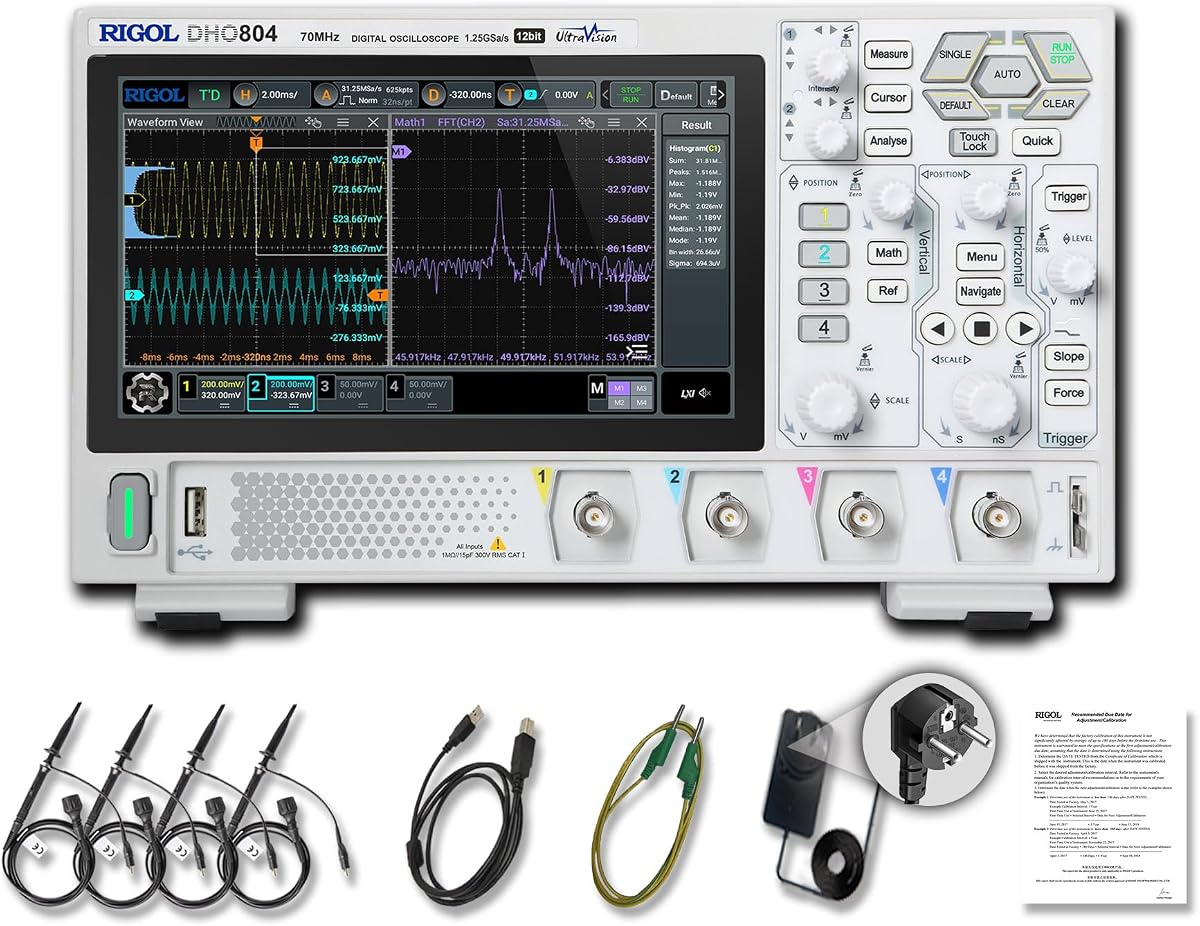
The RIGOL DHO804 represents the premium end of our cheap oscilloscope list, offering lab-grade features at a surprisingly accessible cost. Its 12-bit resolution provides exceptional detail for noise analysis, which is rare in this price segment.
We may earn a commission when you buy through this link, at no additional cost to you.
Equipped with four analog channels and a 1.25GSa/s sampling rate, it can handle complex embedded systems and power electronics easily. The UltraAcquire technology captures glitches down to 1.6ns, ensuring you never miss intermittent issues during testing.
Serial protocol decoding for CAN, I2C, and SPI adds significant value for embedded developers. The 7-inch touchscreen and Flex Knob interface make operation intuitive, while connectivity options like LAN and HDMI facilitate documentation and data sharing in lab settings.
If your work involves debugging intricate digital circuits or requires high-fidelity signal capture, this model is worth the investment. It bridges the gap between professional instruments and hobbyist tools, delivering reliability and performance that justifies its slightly higher cost.
The 12-bit ADC allows for subtle voltage variations to be visualized, improving accuracy for noise and ripple analysis.
Built-in decoding for common serial buses simplifies embedded system debugging by correlating waveforms with data packets.
We may earn a commission when you buy through this link, at no additional cost to you.
The FNIRSI DSO-510 is designed for simplicity and portability, making it perfect for basic electrical troubleshooting. It combines a 10MHz oscilloscope with a signal generator, providing a dual-function tool for educational and light repair use.
We may earn a commission when you buy through this link, at no additional cost to you.
Its infinite afterglow feature helps visualize signal features over time, which is useful for observing intermittent faults. The 48MS/s sampling rate is adequate for audio and basic digital logic, while the 50kHz output generator allows for simple circuit testing.
The one-key AUTO function optimizes parameters automatically, reducing the learning curve for beginners. With a built-in 1000mAh battery and Type-C charging, it remains ready for field use without needing external power sources during short tasks.
For students or hobbyists needing a second scope for basic waveforms, this model offers excellent value. It focuses on core functionality without unnecessary complexity, ensuring you can measure and generate signals efficiently wherever you go.
The DDS generator supports 13 waveform types, aiding in testing amplifier response or basic digital circuits.
Infinite afterglow allows continuous waveform display, helping users spot rare signal anomalies quickly.
We may earn a commission when you buy through this link, at no additional cost to you.
The FNIRSI DPOS350P breaks barriers by offering a 350MHz bandwidth in a handheld format. This model brings lab capabilities like spectrum analysis and frequency response to a portable unit, catering to more advanced RF and signal integrity tasks.
We may earn a commission when you buy through this link, at no additional cost to you.
Its 1GSa/s sampling rate captures high-frequency details accurately. The 7-inch touchscreen simplifies navigation through complex settings like FFT length and cursor readouts, making it easier to analyze EMI or stability issues without external hardware.
Features like the frequency response analyzer and ZOOM functionality allow for detailed filter tuning and loop stability tests. The 8000mAh battery supports extended sessions, while USB-C charging keeps you powered in demanding environments.
If you work with higher-frequency electronics or need spectrum data regularly, this unit provides a unique solution at a competitive price. It significantly expands what you can achieve in the field, bridging the gap between portable and benchtop instruments.
FFT-based analysis from 200KHz to 350MHz helps identify noise sources and harmonic content efficiently.
The 7-inch touchscreen offers intuitive control over settings, improving workflow speed during complex measurements.
We may earn a commission when you buy through this link, at no additional cost to you.
The FNIRSI 2C53P features a 4.3-inch IPS touchscreen, providing a modern interface for waveform observation. It combines a 50MHz scope with a multimeter and generator, similar to the 2C53T but with a larger display for better visualization.
We may earn a commission when you buy through this link, at no additional cost to you.
With 250MS/s sampling and FFT analysis, it supports detailed signal characterization. The high resolution of 480*272 ensures text and grids remain sharp. Its 4000mAh battery aims for about four hours of use, ensuring longevity during field work.
While user feedback varies, the hardware capabilities remain strong. The one-key AUTO function simplifies measurements, and the touch interface speeds up parameter adjustments compared to button-heavy models. Exporting waveforms for analysis is also convenient.
This unit suits those who prioritize a clear, modern interface for viewing complex signals. If you find button navigation tedious, the touchscreen adds a layer of convenience that can improve efficiency in diagnostic workflows.
The IPS touch screen offers wide viewing angles and bright colors, making it easier to read waveforms in different lighting.
FFT spectrum and X-Y modes help analyze harmonic content and phase relationships between signals effectively.
We may earn a commission when you buy through this link, at no additional cost to you.
The FNIRSI 1013D Plus offers a substantial 7-inch touchscreen with 100MHz bandwidth. It targets users needing a portable scope with desktop-like interface convenience. Its capacitive touch and gesture support make measuring parameters fast and intuitive.
We may earn a commission when you buy through this link, at no additional cost to you.
With 1GSa/s sampling, it handles digital signals accurately. The waveform image manager allows storing up to 1000 screenshots, useful for documenting issues. The 6000mAh battery supports four hours of operation, matching the longevity of larger benchtop instruments.
High-voltage protection ensures safety during automotive or mains testing. The touch interface eliminates the need to read scales manually by providing direct peak-to-peak and frequency readings. This reduces human error during complex diagnostics.
If screen real estate is a priority for your testing, this model delivers a desktop experience on the go. The combination of bandwidth and display size makes it versatile for education and detailed circuit analysis in field conditions.
Gestures like zooming and panning allow rapid exploration of waveform details without menu diving.
Extensive storage for screenshots and waveforms ensures you can keep a history of tests for reporting.
We may earn a commission when you buy through this link, at no additional cost to you.
The FNIRSI 2C23T holds one of the highest user ratings due to its reliability and straightforward design. It offers a 10MHz bandwidth with a multimeter and signal generator, perfect for basic electronics and educational environments.
We may earn a commission when you buy through this link, at no additional cost to you.
Its FPGA+MCU hardware ensures stable performance. The multimeter mode includes continuity and diode checks, which is helpful for component testing. The 3000mAh battery provides around six hours of standby time, ensuring the device is ready when needed.
Waveform storage and comparison features let you reference saved images against live signals. While it lacks advanced analysis, it excels at fundamental tasks. The simplicity means fewer settings to manage, making it less intimidating for newcomers.
For users who prioritize reliability and simplicity over high bandwidth, this is an excellent choice. It handles most low-frequency applications well, providing essential tools without overwhelming complexity or high cost.
Multimeter capabilities support continuity and diode checks, adding value beyond just waveform tracing.
Saved waveforms can be displayed alongside new ones, facilitating visual comparison for fault detection.
We may earn a commission when you buy through this link, at no additional cost to you.
The FNIRSI 2D15P offers 100MHz bandwidth and 500MS/s sampling in a portable 3-in-1 unit. It targets users needing higher fidelity than entry-level devices but still want handheld convenience. The TRMS multimeter ensures accurate measurements of non-linear loads.
We may earn a commission when you buy through this link, at no additional cost to you.
Its quiet fan cooling keeps the device stable during extended runs, avoiding overheating issues common in dense electronics. The FPGA+MCU architecture ensures precise signal capture, while memory depths of 1M allow detailed waveform storage for later review.
Waveform and math functions support complex diagnostics like amplitude and phase analysis. The 5000mAh battery supports extended field use, though the fan may draw more power during continuous operation in hot environments.
For those who need 100MHz bandwidth on a budget, this model strikes a practical balance. It provides enough headroom for most digital circuits while maintaining the portability required for automotive or on-site diagnostics.
True RMS multimeter readings ensure precise current and voltage measurements even with distorted waveforms.
Built-in fan cooling allows stable operation during long tests, preventing thermal shutdowns.
We may earn a commission when you buy through this link, at no additional cost to you.
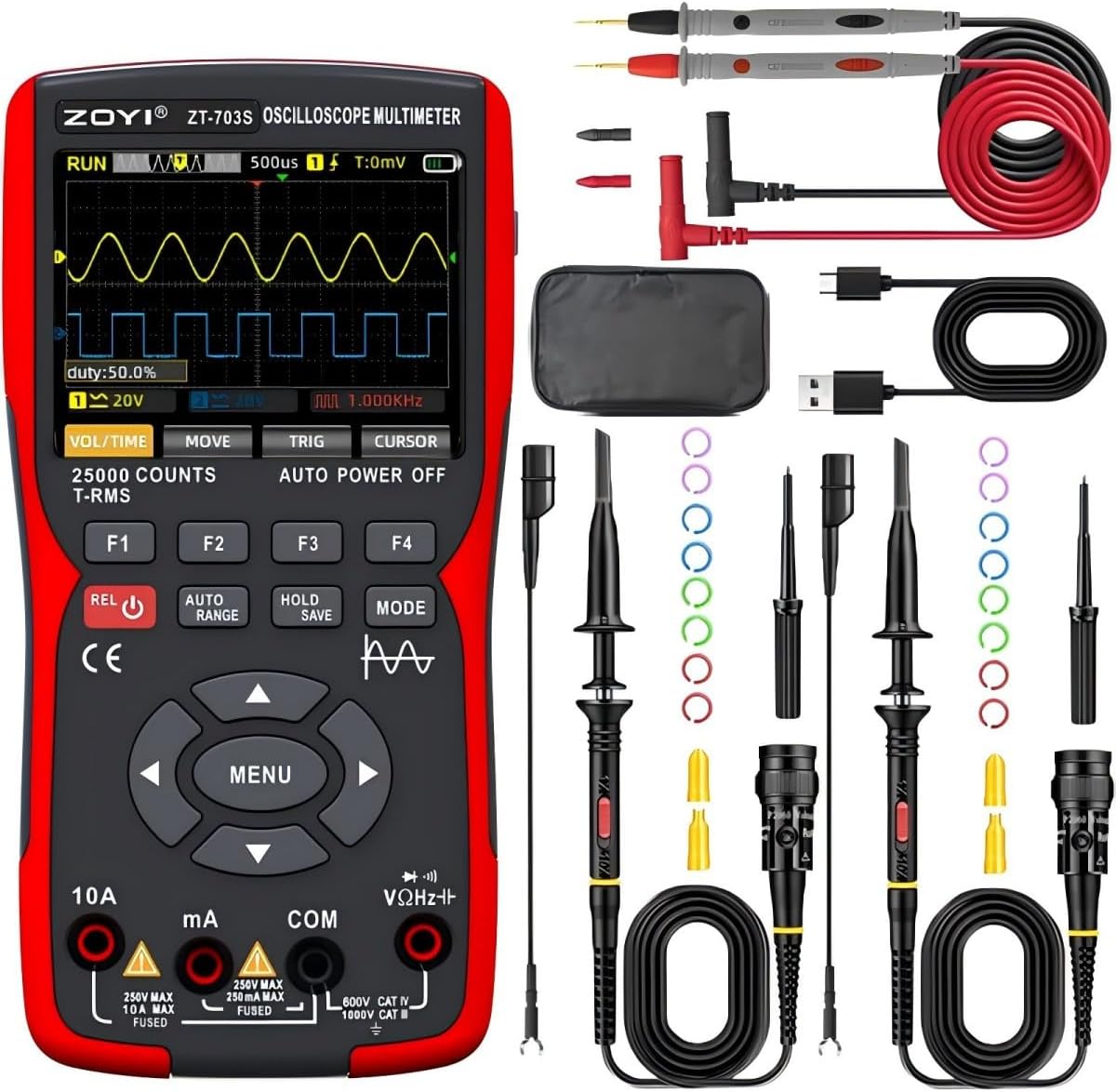
This generic 3-in-1 model is optimized for automotive diagnostics with a 50MHz bandwidth and 280MSa/s high-speed mode. Its auto waveform recognition function helps when dealing with unknown signals, making it easier to identify faults quickly.
We may earn a commission when you buy through this link, at no additional cost to you.
The high-speed mode increases sampling to capture transient events better. The 25000-count multimeter provides precision for resistance and capacitance checks. Type-C charging and data transfer make it modern and easy to update or backup data.
Users report high satisfaction due to its robust build and specialized automotive features. The signal generator allows testing of sensors or injectors directly. While branding is minimal, the feature set is strong for vehicle maintenance.
If your primary focus is automotive repair, this unit offers the right tools without unnecessary extras. Its auto recognition and high-speed capabilities make it a reliable partner for identifying intermittent electrical issues in modern vehicles.
Automatic waveform identification helps novice users interpret complex signals without manual tuning.
Designed with automotive applications in mind, it handles pulse waves and sensor signals effectively.
We may earn a commission when you buy through this link, at no additional cost to you.
Selecting the right affordable oscilloscope involves balancing technical specifications with your specific application needs. Here are key factors to consider.
Bandwidth determines the highest frequency signal your scope can accurately measure. For basic audio and low-speed digital logic, 20MHz to 50MHz is sufficient. However, if you work with faster processors or RF signals, look for 100MHz or more to avoid signal distortion.
Always choose a scope with at least five times the highest frequency you intend to test for accurate waveforms.
Sampling rate indicates how many data points the scope captures per second. Higher sampling rates allow better visualization of fast edges and glitches. For 50MHz bandwidth, a 250MS/s rate is a good baseline. Ensure the real-time sampling meets your needs rather than just interpolated rates.
Prioritize real-time sampling over equivalent-time sampling to avoid missing intermittent faults.
Most budget models offer two channels, which is enough for comparing input and output signals. Four-channel scopes like the RIGOL DHO804 are useful for complex embedded systems or power supply debugging where multiple rails need monitoring.
Two channels are usually sufficient for basic hobbyist projects and maintenance tasks.
Larger screens make it easier to read waveforms and menus. Handheld units often feature 2.8-inch to 4.3-inch displays, while portable models may reach 7 inches. Touchscreens can improve usability but may drain battery faster.
Choose a display size that allows comfortable viewing of waveform details without excessive zooming.
For field work, look for built-in lithium batteries. Capacities range from 1000mAh to 8000mAh, affecting usage time from two to eight hours. Lightweight chassis designs ensure you can carry the unit to work sites or classrooms easily.
Ensure the device includes a charging port like USB-C for convenient power replenishment.
Some models include multimeters or signal generators, adding value and reducing tool count. Protocol decoders for I2C or UART help embedded engineers significantly. FFT spectrum analysis is critical for noise and EMI troubleshooting.
Evaluate whether these extra features justify the price increase compared to standalone scopes.
Always check the maximum input voltage to ensure safety during mains or automotive testing. Most handhelds support up to 400V, but always use proper probes to prevent damage to the scope or personal injury.
Adhere to the manufacturer's safety guidelines to avoid overloading the device.
USB or Type-C ports enable firmware updates and data export. Some high-end models offer LAN or HDMI for documentation. Ensure the connectivity matches your workflow, especially if you need to archive waveforms digitally.
Modern interfaces like USB-C are preferred for durability and versatility.
Before starting, always calibrate the probes using the square wave output on the device. Connect the probe to the channel and attach it to the calibrator terminal. Adjust the probe trimmer until the square wave appears flat without overshoot or rounding.
To measure a signal, set the probe attenuation correctly in the menu. Turn on AUTO to let the scope adjust voltage and time scales automatically. If you need precise measurements, use cursors to measure amplitude and frequency manually.
To extend the life of your oscilloscope, store it in a dry and cool place. Avoid dropping the unit, especially handheld models. Regularly update the firmware if supported to benefit from bug fixes and performance improvements.
For Arduino and most microcontroller projects, a bandwidth of 20MHz to 50MHz is sufficient. This range covers typical digital signals and communication protocols like UART or SPI, allowing you to view clock lines and data without distortion.
You can measure mains voltage if the scope supports at least 400V input and you use high-voltage probes. Never connect the scope directly to mains without a probe or isolation transformer, as this poses a severe safety risk.
Real-time sampling captures data points in actual time, which is necessary for non-repetitive signals. Equivalent sampling assumes the signal repeats to construct a waveform. For general electronics, real-time sampling is essential to avoid missing glitches.
Vertical resolution determines how finely the scope can distinguish voltage changes. Higher resolution like 12-bit allows detecting smaller noise or ripple, which is vital for power supply analysis compared to standard 8-bit scopes.
Use the generator output to send a known waveform into your circuit. Observe the response on the oscilloscope channel. This allows you to test frequency response or verify if a circuit is modifying signals correctly.
Many modern budget scopes support exporting via USB or Type-C. Check the product details for file formats like PNG or CSV. Exporting helps document faults for analysis or sharing with others remotely.
Our top picks range from the pocket-sized FNIRSI DSO152 to the powerful RIGOL DHO804, covering diverse needs and budgets. Whether you need a simple tool for home repairs or advanced features for embedded development, there is a model here.
Prioritize bandwidth and sampling rate based on the highest frequency signals you encounter. Do not overlook portability and battery life if you work on-site. Combining these specs with your budget will guide you to the right choice.
Remember that prices fluctuate, so check current deals before finalizing your purchase. Investing in a reliable tool now can save time and money on diagnostics in the long run. We hope this guide helps you find the perfect scope.