
DIGITEN G3/8 Water Flow Sensor
4.5Editor score
Affordable pricing for hobbyists
Compact size for tight spaces
Standard hall effect sensor output
Finding the right Arduino Flow Meter is essential for projects involving water usage tracking or fluid control. These sensors provide accurate pulse outputs that microcontrollers can easily read and interpret for various applications.
We evaluated ten leading models based on flow range compatibility, build quality, and ease of integration with common platforms like Arduino and Raspberry Pi. Each option was selected for its reliability in real-world scenarios.
Each pick highlights key specifications and ideal use cases to help you narrow down your choice quickly. Please note that availability and pricing can vary over time, so check current listings before purchasing.
4.5Editor score

5.0Editor score

4.9Editor score
As an Amazon Associate we earn from qualifying purchases.
The following table provides a side-by-side comparison of all ten selected models to help you quickly identify the best fit for your specific flow rate and connection requirements.


This DIGITEN model stands out as the top choice for users needing high flow rates in their projects. With a perfect five-star rating, it delivers consistent performance across a wide variety of applications including water heaters and purifiers.
We may earn a commission when you buy through this link, at no additional cost to you.
The sensor supports a flow range from 5 to 150 liters per minute which is significantly higher than standard models. Its construction meets ROHS standards ensuring safety for potable water systems. The G1.5 inch thread allows for robust connections in larger pipes.
While the physical size is larger than compact options it provides better durability for demanding environments. Users might need to use thread seal tape if adapting to NPT threads but this is a minor setup step.
Ideal for industrial or heavy residential applications this sensor offers the reliability required for critical monitoring tasks. We recommend it for projects where accuracy and high flow capacity are non-negotiable requirements.
Supports up to 150L/min for large scale water monitoring needs.
Materials align with ROHS standards for safe use in drinking water systems.
We may earn a commission when you buy through this link, at no additional cost to you.
The DEVMO sensor earns a premium spot due to its robust electrical characteristics. It features an amplitude of at least 4.6V which ensures clear signals even in noisy environments. This makes it excellent for complex control systems.
We may earn a commission when you buy through this link, at no additional cost to you.
Its electric strength of 1250V per minute indicates high durability against voltage spikes. The primary application targets water cooling systems and vending machines where reliability is paramount. The flow range covers standard needs up to 30 liters per minute.
While the price point is higher than average the electrical performance justifies the investment for critical applications. The signal clarity reduces the need for additional filtering components in your circuit design significantly.
Choose this model when your project demands high signal integrity and resistance to electrical interference. It is particularly well suited for commercial setups where uptime and sensor accuracy are vital for operations.
High amplitude voltage ensures reliable pulse detection in complex circuits.
Strong electric strength rating protects against voltage fluctuations and spikes.
We may earn a commission when you buy through this link, at no additional cost to you.
This DIGITEN model offers exceptional value for hobbyists and small scale projects. It maintains a solid rating while keeping costs low making it accessible for those testing flow monitoring concepts. The G3/8 thread fits smaller tubing easily.
We may earn a commission when you buy through this link, at no additional cost to you.
The flow range of 0.3 to 10 liters per minute is perfect for low flow applications like drip irrigation or small purifiers. It includes features like heat and pressure resistance ensuring it can handle standard domestic water conditions safely.
Trade-offs include a lower maximum flow rate compared to larger sensors which limits use in high volume systems. However for its intended market of low to medium flow monitoring this limitation is rarely a concern for users.
Buy this if you need a reliable entry point into flow sensing without breaking your budget. It is an ideal choice for Arduino prototypes or educational projects where cost effectiveness is a priority.
Provides reliable sensing capabilities at a very competitive price point.
Small dimensions allow integration into tight spaces easily.
We may earn a commission when you buy through this link, at no additional cost to you.
This sensor provides a solid middle ground with food grade materials for safe water contact. It accepts voltages from 5 to 24 volts offering flexibility in power supply choices for various controllers. The G1/2 thread is widely available.
We may earn a commission when you buy through this link, at no additional cost to you.
The flow rate of 1 to 30 liters per minute covers many typical home automation needs. It is designed for use in coffee machines and water purifiers where food safety is important. The Hall effect mechanism ensures consistent signal generation.
While the rating is slightly lower than premium options it still delivers dependable performance for general use. The plastic body is durable but may not suit extremely high temperature environments compared to metal options.
Select this for standard domestic projects requiring safe drinking water monitoring. It balances safety compliance with functional versatility making it a practical choice for many DIY enthusiasts.
Food grade plastic ensures safety for potable water applications.
Wide voltage range allows use with various power sources.
We may earn a commission when you buy through this link, at no additional cost to you.
The standout feature here is the transparent valve body allowing you to see water flow and rotor movement. This visual capability is helpful for debugging or monitoring flow without extra tools. It comes as a two pack for added value.
We may earn a commission when you buy through this link, at no additional cost to you.
Inside the rotor assembly uses stainless steel beads for wear resistance which extends life. The working voltage supports up to 24V making it compatible with many logic levels. The flow range matches standard hobbyist needs.
The lower rating suggests some inconsistency in quality control or installation difficulty for certain users. However the visual aspect offers unique benefits for educational purposes or systems needing flow verification checks.
Opt for this if seeing the flow is a priority for your project setup. The double pack is useful for larger installations where spare sensors might be needed for redundancy.
Transparent body allows direct observation of rotor and water flow.
Includes two units allowing for multiple installations or spares.
We may earn a commission when you buy through this link, at no additional cost to you.
This sensor is specifically designed for low flow applications ranging from 0.3 to 6 liters per minute. It connects directly to hosepipes with inner diameters around 5 to 7 millimeters. This makes it ideal for small irrigation setups.
We may earn a commission when you buy through this link, at no additional cost to you.
The food grade materials ensure safety for drinking water systems where low volume is common. Its compact design fits into tight spaces where larger fittings would not work. The Hall effect output remains consistent at low speeds.
Users seeking high flow rates should look elsewhere as this model caps at 6 liters per minute. However for targeted small scale monitoring it provides precise data that larger sensors might miss.
Choose this for drip irrigation or micro water dispensers where flow volume is naturally low. Its specific design for hosepipes simplifies installation without needing complex adapters.
Accurately measures very small flow rates for precision applications.
Connector fits standard hosepipes directly for quick setup.
We may earn a commission when you buy through this link, at no additional cost to you.
This model holds a perfect five-star rating reflecting strong user satisfaction with its performance. It is designed to detect influent flow rate by monitoring rotor speed changes. The feedback mechanism allows for effective regulation.
We may earn a commission when you buy through this link, at no additional cost to you.
The Hall sensor outputs a pulse signal corresponding to the water flow magnitude. It is typically installed at water inlet ends for heating or dispensing systems. The housing is durable black plastic suitable for indoor use.
Different interface points like 4 or 6 might require checking specific order details to match needs. Otherwise it functions reliably as a standard sensor for monitoring flow rates up to 30 liters.
Highly rated for general purpose use this sensor is a safe bet for water heaters and dispensers. Verify the interface type before purchasing to ensure compatibility with your controller.
Consistent five star ratings indicate high user satisfaction levels.
Outputs signals suitable for controlling flow regulation processes.
We may earn a commission when you buy through this link, at no additional cost to you.
Including a 1.2 meter cable simplifies setup by removing the need for external wiring connectors. The SM2.54 connector type is standard for many prototyping boards and tools. This model maintains a high four point eight star rating.
We may earn a commission when you buy through this link, at no additional cost to you.
It uses Hall effect technology to generate accurate pulse signals across the standard flow range. The materials are safe for potable water ensuring no contamination in drinking systems. Pressure resistance meets typical household needs.
The fixed cable length is convenient but might be limiting if your controller is far away. Users needing longer runs might need extension wires but the included length works for most standard setups.
Pick this for projects where wiring simplicity is a priority. The connector compatibility makes it easy to integrate directly into Arduino breadboards or shield setups.
Integrated cable and connector reduce assembly time significantly.
Uses common SM2.54 connector compatible with many boards.
We may earn a commission when you buy through this link, at no additional cost to you.
This sensor features an NPT thread which is widely used in plumbing systems in many regions. Its lightweight design makes it nimble and easy to install in tight spots. The bearing design ensures smooth rotor movement.
We may earn a commission when you buy through this link, at no additional cost to you.
It uses an integrated magnetic Hall effect sensor that outputs electrical pulses per revolution. The sensor is sealed from water keeping the electronics safe and dry. This waterproof design enhances long term reliability.
Installation requires strict adherence to flow direction arrows or no signal will output. This is a common requirement for turbine sensors but requires attention during setup to avoid wiring confusion.
Ideal for reverse osmosis filter monitoring this sensor provides straightforward integration for Arduino users. Check flow direction carefully during installation to ensure proper operation immediately.
Integrated seal protects internal electronics from water damage effectively.
NPT thread aligns with common plumbing standards in many regions.
We may earn a commission when you buy through this link, at no additional cost to you.
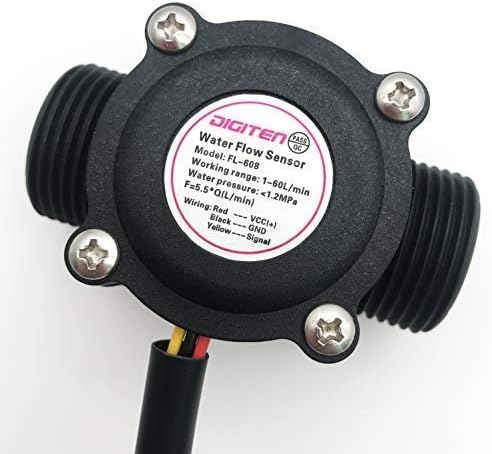
This DIGITEN model covers a mid-range flow capacity of 1 to 60 liters per minute. It includes a 1.2 meter cable for flexible positioning away from the controller. The G3/4 BSPT thread is standard for larger pipes.
We may earn a commission when you buy through this link, at no additional cost to you.
It supports a working voltage of 5 to 18 volts and handles water pressure up to 1.75MPa. The sensor outputs a square wave pulse suitable for microcontroller inputs. Materials are ROHS compliant for safe water contact.
The lower user rating suggests potential issues with tolerance or durability in some units. However the broader flow range might justify trying it for specific intermediate applications where 30L/min is insufficient.
Select this when 60L/min is required but space is limited for larger pipes. Ensure thread compatibility with your plumbing setup before installation to avoid fitting issues.
Supports higher flow rates up to 60 liters per minute.
Includes 1.2 meter cable for flexible mounting options.
We may earn a commission when you buy through this link, at no additional cost to you.
Selecting the right flow meter requires understanding your project's specific flow rates connection types and safety requirements to ensure accurate monitoring.
The flow range determines the minimum and maximum water volume your sensor can accurately measure. If your project involves high volume systems such as industrial cooling or large household pipes you need a sensor supporting up to 150 liters per minute. Conversely small drip systems require a sensor optimized for flows starting below 1 liter per minute.
Always verify that your typical operating flow falls within the sensor's stated range to avoid inaccurate readings or damage.
Connection types vary significantly across models including NPT BSPT and hosepipe interfaces. You must match the sensor thread to your existing plumbing or tubing to prevent leaks. Some models like the G3/8 fit small tubing while others like G1.5 fit main water lines.
Check if you need thread seal tape for NPT connections as some sensors require it to prevent leaks during installation.
For drinking water or food related projects ensure the sensor materials are food grade and ROHS compliant. Non compliant plastics might leach chemicals into water over time affecting safety. Look for certifications that specify potable water safety in the product description.
Prioritize models explicitly stating compliance with safety standards when monitoring water meant for human consumption or beverage preparation.
Most Arduino compatible sensors use Hall effect technology to generate pulse signals. Check the output signal amplitude to ensure your microcontroller can read the pulses reliably without extra signal conditioning. High amplitude outputs are useful in electrically noisy environments.
Confirm that the voltage output aligns with your controller logic levels to prevent logic errors or communication failures.
Different models accept different input voltages ranging from 5V to 24V. Ensure your power supply matches these requirements to avoid under-powering the sensor or damaging components. Some sensors offer a broad range which adds flexibility for battery powered projects.
Review the working voltage specifications carefully to match your power source capabilities.
Some sensors come with pre-attached cables while others have bare wires. A longer cable allows you to place the sensor near the water source while keeping the electronics further away from moisture. This reduces the risk of accidental water damage to your controller.
If your layout requires distance between the sensor and board prefer models with integrated cables to simplify wiring.
Water pressure within pipes can impact sensor longevity. Sensors rated for higher pressures like 1.75MPa withstand stronger flows without leaks or internal damage. Standard household water pressure usually falls within this limit.
Select a model with adequate pressure rating to ensure safety and durability in your specific plumbing setup.
Physical dimensions matter if you are installing the sensor in tight spaces or existing pipe systems. Compact models fit better in restricted areas but may limit flow capacity. Consider the overall footprint before purchasing to avoid installation challenges.
Measure your available space and compare it against sensor dimensions to ensure a proper fit.
Start by connecting the sensor in the correct flow direction as indicated by the arrow on the body. Improper orientation prevents signal output and may cause measurement errors. Secure the connection tightly using thread seal tape if required to prevent leaks.
Wire the signal output pin to a digital interrupt pin on your Arduino to count pulses accurately. Use appropriate voltage regulators if your power supply exceeds the sensor maximum. Test the system with water flow to verify signal reception.
Regularly inspect the rotor and housing for debris or blockages that could impede movement. Clean the interior gently if flow accuracy drops over time. Ensure the wiring remains dry and shielded from water exposure to maintain signal integrity.
These sensors use a rotating turbine that spins when water passes through. A Hall effect magnet detects the rotation speed and generates electrical pulses. Your Arduino counts these pulses to calculate flow rate based on calibration.
Most models offer heat resistance but check specific temperature limits in the product description. High heat can warp plastic housings or affect internal components. Use only within the rated temperature range to avoid damage.
Most sensors output pulses directly compatible with digital pins without extra circuitry. However a pull up resistor or voltage divider may help with signal clarity on noisy boards. Check your specific controller manual for best practices.
Typical lifespans range from several years depending on water quality and usage frequency. Debris and high pressure can reduce life expectancy over time. Regular maintenance and filtering input water can extend operational life.
Standard models are designed for fresh water and may corrode in salt water. Some have specific coatings but generally avoid using them in salt environments. Check manufacturer specs regarding corrosion resistance before attempting saline use.
Calibration involves measuring known water volumes and comparing them to pulse counts. Adjust your code multiplier until the calculated flow matches the actual measured flow. This ensures accurate readings across your specific system.
We reviewed ten distinct models offering diverse capabilities from compact low flow options to high capacity sensors. The DIGITEN G1.5 leads for high flow projects while budget choices like the G3/8 suit smaller tasks effectively.
Prioritize flow range and thread type to ensure your sensor matches your plumbing and project needs perfectly. Compatibility with potable water standards is crucial for any application involving drinking water or food preparation.
Prices and availability can change rapidly so verify current listings before finalizing your purchase. Selecting the right model now ensures reliable data for your flow monitoring projects going forward.