
M-AUDIO M-Track Duo USB Audio Interface
4.4Editor score
Two combo XLR inputs
Zero latency monitoring
Includes MPC Beats Software
This guide compares the top Firewire audio interfaces for PC, analyzing connectivity, sound quality, compatibility, and features to help you choose the right
Finding the right Firewire audio interface for PC can be challenging as older technology meets modern recording needs. Many professionals still rely on the stability and low latency that Firewire provides for high-quality audio capture and monitoring.
We evaluated ten top-rated products based on connectivity options, sound fidelity, driver support, and overall value. Our analysis focuses on how each interface performs with PC systems, ensuring reliable performance for recording, mixing, and live streaming tasks.
Each pick highlights specific strengths and use cases so you can match the interface to your workflow. Note that availability and pricing may shift frequently, so verify current stock before making your final purchasing decision today.
4.4Editor score

4.4Editor score

5.0Editor score
This side-by-side comparison outlines the core specifications and capabilities of each interface to help you decide quickly. We focus on port types, channel counts, sample rates, and software bundles to highlight where each model excels in real-world usage.




The PCIE-1394A expansion card stands out as a critical component for users who need to integrate legacy Firewire devices into modern desktop PCs. With a solid 4.4 rating from users who rely on it for data transfer from DV camcorders and audio interfaces, it delivers consistent performance across multiple Windows versions. Its ability to support both 6-pin and 4-pin connectors ensures compatibility with a wide range of older audio hardware.
We may earn a commission when you buy through this link, at no additional cost to you.
Key strengths include its auto-detection capability and high-speed data transfer rates of up to 400Mbps. The card negotiates connection speeds dynamically, ensuring stable communication even with devices that support lower speeds. This flexibility makes it ideal for studios that mix old and new gear without needing complex adapters. The included low-profile bracket adds further versatility for smaller cases.
One trade-off is the potential need for legacy drivers on newer systems. While most Windows versions support plug-and-play functionality, some setups may require manual installation. This is a minor hurdle compared to the alternative of losing access to legacy audio interfaces. Users should check their PCIe slot availability before purchase since it requires a dedicated x1 slot.
If you depend on Firewire audio interfaces for low latency and stability, this card is the go-to solution for PC users. It bridges the gap between modern computers and professional legacy gear effectively. We recommend it for home studios and professionals who need reliable Firewire connectivity without upgrading their entire audio ecosystem.
It supports IEEE 1394A standards ensuring your old camcorders and audio gear work seamlessly with new PCs.
With 400Mbps transfer rates, you can move large audio files or stream data without noticeable lag.
We may earn a commission when you buy through this link, at no additional cost to you.
The RME Fireface UFX II is a flagship audio interface that offers pristine sound quality and extensive connectivity for serious producers. Boasting a perfect 5.0 rating, it excels in professional environments where reliability and fidelity are non-negotiable. The interface delivers 24-bit/192kHz resolution, ensuring your recordings capture every nuance of your performance without compression artifacts or noise.
We may earn a commission when you buy through this link, at no additional cost to you.
Its standout features include four high-quality mic/instrument preamps and ARC USB remote integration for hands-on control. The 30-in/30-out capability allows for complex multitrack recordings and live streaming setups without additional hardware. Direct USB recording ensures that you can capture audio directly to your storage without burdening your CPU, which is crucial for large sessions.
While the price is significant, the build quality and feature set justify the investment for professionals. The learning curve for all the features can be steep for beginners, but once configured, it becomes an intuitive tool. Users should ensure their PC has a USB 2.0 port or adapter to maximize its potential effectively.
This interface is ideal for musicians and producers who demand top-tier performance and expandability. If you need a central hub for your entire studio with high-fidelity conversion, the UFX II is a superior choice. It remains a gold standard for those willing to invest in long-term audio gear.
The 24-bit/192kHz resolution ensures your recordings maintain professional quality suitable for commercial release.
ARC USB remote lets you manage settings physically, which speeds up workflow during recording sessions.
We may earn a commission when you buy through this link, at no additional cost to you.
The M-AUDIO M-Track Duo is an excellent starting point for podcasters and home recordists looking for reliable audio capture without breaking the bank. With a strong 4.4 rating, it delivers clear sound at 48kHz resolution, which is sufficient for most vocal and instrument recordings. The interface includes transparent Crystal Preamps that ensure your microphones sound their best right out of the box.
We may earn a commission when you buy through this link, at no additional cost to you.
It features two combo XLR inputs that accept microphones and instruments with phantom power support. The USB/Direct switch allows for zero latency monitoring, which is crucial for performers who need to hear themselves in real time. Additionally, the inclusion of MPC Beats software adds immediate value by providing production tools to start creating music instantly.
The main limitation is the 48kHz resolution limit compared to higher-end models. However, for streaming, podcasting, and casual recording, this is rarely a bottleneck. The build is solid enough for regular use but lacks the ruggedness of professional units. It is portable and USB bus-powered, making it convenient for travel.
We recommend this interface for beginners or budget-conscious creators who need dual input capability. It offers a perfect balance of features and cost for small setups. If you want to start recording vocals and guitar simultaneously without spending a fortune, the M-Track Duo is a trusted choice.
Two combo inputs let you record two sources at once, ideal for duos or multi-instrument setups.
Included MPC Beats software gives you a full production suite to jumpstart your music career.
We may earn a commission when you buy through this link, at no additional cost to you.
The Focusrite Scarlett 2i2 4th Gen brings studio-quality sound to home studios with its massive 120dB dynamic range. Rated 4.6 by users, it is particularly celebrated for its Auto Gain feature that sets perfect levels automatically, saving time during setup. The Air mode lifts vocals and guitars to the front of the mix, adding rich harmonic drive to recordings.
We may earn a commission when you buy through this link, at no additional cost to you.
It includes industry-leading recording software and plugins that provide everything needed to record and mix music. The converters are shared with flagship interfaces, ensuring high fidelity for critical listening and production. USB-C connectivity ensures compatibility with modern computers and faster data transfer speeds than older USB versions.
While it is more expensive than entry-level options, the added features and software value justify the cost. Some users may find the knob layout basic compared to more complex interfaces, but it remains intuitive for most. It is USB bus-powered and portable, making it easy to take to sessions.
This interface is perfect for singers and guitarists who want professional results without deep technical knowledge. If you want your voice to shine in a mix effortlessly, the Air mode makes a noticeable difference. It is a reliable and modern choice for serious songwriters and content creators.
Auto Gain sets the optimal input level for you, preventing clipping and maximizing signal clarity.
Air mode adds a bright, open character to vocals, helping them cut through the mix naturally.
We may earn a commission when you buy through this link, at no additional cost to you.
The RME Fireface UCX II is designed for professionals who need stability and portability in a compact form factor. With a 4.3 rating, it is highly regarded for its robust driver support across macOS, Windows, and iOS platforms. It offers 20-in/20-out capability, which is ample for most home studio and mobile recording needs without requiring additional expansion.
We may earn a commission when you buy through this link, at no additional cost to you.
Its USB 2.0 connection ensures stable performance while maintaining high fidelity. The interface is known for its high power headphone output, driving even difficult headphones with clarity. It includes MIDI I/O for hardware synthesizer connectivity, making it a complete hub for electronic music production and live performance.
While it is priced higher than entry-level interfaces, the reliability and feature set are justified for pros. It may be overkill for beginners, but the build quality ensures it lasts for years of daily use. Users should have a PC or laptop with enough USB bandwidth to handle all channels simultaneously.
We recommend the UCX II for touring musicians and producers who value driver stability above all else. It is an investment in reliability and sound quality that pays off over time. If you need an interface that works seamlessly across multiple devices without dropouts, this is an excellent option.
Works smoothly on Mac, Windows, and iOS ensuring you can record anywhere without driver headaches.
MIDI I/O included allows direct control of hardware synths without extra converters or cables.
We may earn a commission when you buy through this link, at no additional cost to you.
The RME Fireface UFX III represents the pinnacle of audio interface technology with its 94-in/94-out capability and USB 3.0 connectivity. Rated 5.0 by professional users, it delivers flawless performance for complex multi-track recordings and live broadcasting. The inclusion of DSP effects means you can process audio in real time without loading your computer CPU.
We may earn a commission when you buy through this link, at no additional cost to you.
It supports ADAT AES/EBU digital I/O for connecting extensive external gear like digital mixers and converters. Direct USB recording allows you to save audio directly to an external drive, ensuring safety during live performances. The interface is robustly built and offers precise control over every parameter needed in a professional studio.
The main consideration is the significant investment required for this unit. You also need a PC with a capable USB 3.0 port to utilize its full potential. However, for those who need a single device to handle every studio task, the UFX III is unmatched in capability and reliability.
This is the ultimate choice for large studios and broadcast environments that require maximum flexibility. If you need to connect dozens of channels and process them efficiently, this interface offers the best performance available. It is a future-proof investment for serious audio engineers.
With 94 channels, you can record entire bands and orchestras without external mixing hardware.
Integrated DSP effects let you process tracks in real time without taxing your computer resources.
We may earn a commission when you buy through this link, at no additional cost to you.
The RME Fireface 802 FS is a powerhouse in the mid-range professional audio interface market. Rated 5.0 by engineers, it offers 30-in/30-out channels and robust DSP effects that allow for flexible routing and processing. It supports multiple operating systems including Windows, Mac, and Linux, making it versatile for diverse studio environments.
We may earn a commission when you buy through this link, at no additional cost to you.
One of its standout features is the inclusion of two headphone outputs, which is rare at this price point. This allows engineers to cue performers independently during recording sessions without needing an external mixer. The ADAT S/PDIF I/O expands connectivity further, enabling digital links with other studio gear.
While it is more complex than entry-level interfaces, the control and reliability are unmatched for professional work. The drivers are famously stable, ensuring your recording sessions run without technical interruptions. It requires a dedicated power supply, which is a standard trade-off for this level of performance.
We recommend this interface for engineers and studios that need multiple headphone mixes and robust routing. It is a reliable workhorse for critical listening and tracking. If you value stability and detailed control over your audio signal path, the 802 FS is a top contender.
Two headphone outputs let you cue performers independently during sessions without extra gear.
Built-in DSP allows real-time processing without CPU load, ensuring smooth performance.
We may earn a commission when you buy through this link, at no additional cost to you.
The PIYONE USB C Audio Interface stands out for its modern design and ease of use. Rated 4.4, it delivers high-fidelity 24-bit/192kHz audio with a plug-and-play setup that requires no driver installation. It is ideal for content creators and musicians who need a simple solution to start recording immediately.
We may earn a commission when you buy through this link, at no additional cost to you.
Features like the loopback function allow you to mix system audio with your voice for streaming without extra software. The illuminated control rings add a professional look and ensure visibility in dim lighting. It is bus-powered via USB-C, eliminating the need for external power supplies and keeping your setup clean.
While the build feels light compared to heavy steel boxes, it remains durable for regular use. The 3.5mm headphone jack ensures compatibility with standard headsets without adapters. Users should note that it is a compact device suitable for mobile setups rather than heavy-duty studio environments.
We recommend this interface for streamers and travelers who prioritize portability and ease of use. It provides professional sound quality without the complexity of driver installation. If you want a stylish and simple way to capture high-quality audio on the go, this is a great option.
Loopback allows mixing game audio and voice simultaneously for streaming without external software.
Class-compliant design means no drivers needed, letting you start recording instantly on PC.
We may earn a commission when you buy through this link, at no additional cost to you.
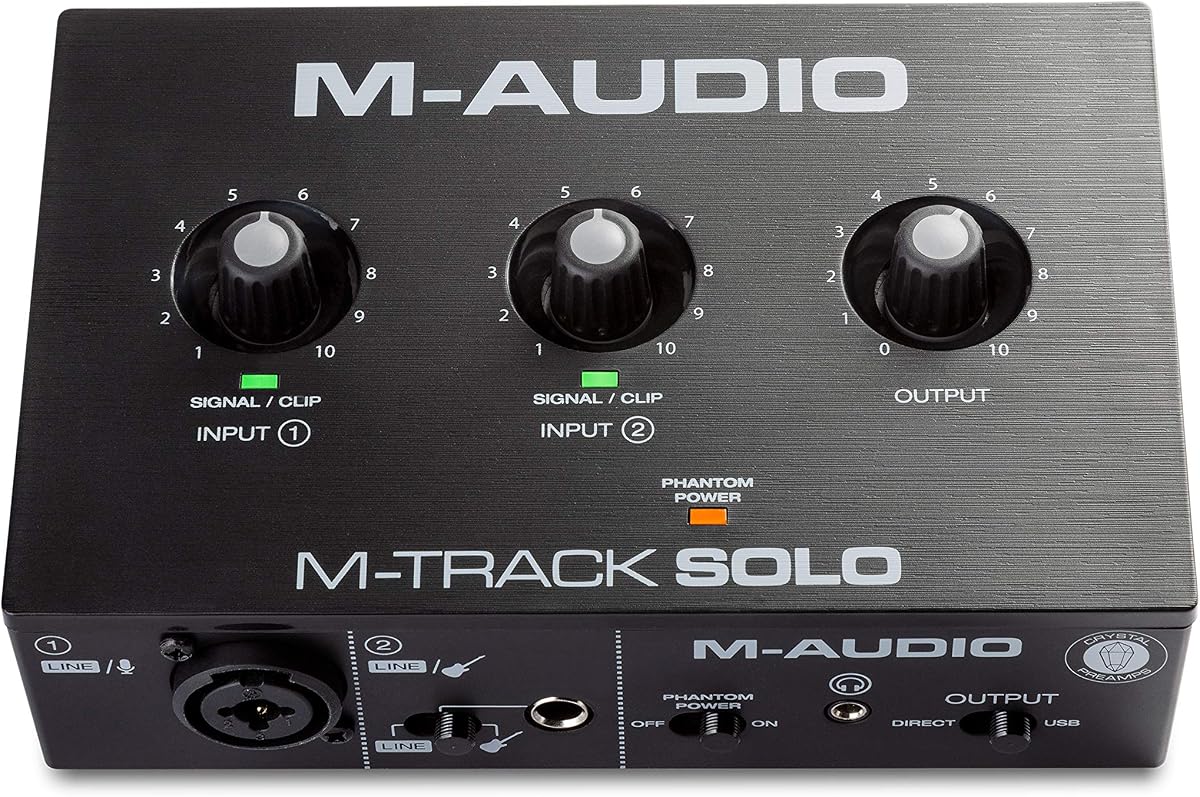
The M-AUDIO M-Track Solo is designed for those who need a simple and affordable way to record vocals or instruments. With a 4.3 rating, it delivers 48kHz resolution audio via a single combo XLR input and a dedicated instrument input. The transparent Crystal Preamp ensures your microphone sounds clear and professional without distortion.
We may earn a commission when you buy through this link, at no additional cost to you.
It features a USB/Direct switch for zero latency monitoring, allowing you to hear yourself without delay during recording. The inclusion of MPC Beats software provides essential production tools to help you create music right away. It is compact and USB bus-powered, making it easy to store and transport.
The main limitation is the single input and RCA outputs, which are less versatile for multi-channel setups. However, for solo artists or podcasters, this functionality is often sufficient. The build is sturdy enough for regular use and provides a straightforward user experience without unnecessary buttons.
We recommend this interface for solo musicians and podcasters on a tight budget. It offers a perfect starting point for anyone learning to record and produce. If you need to connect a mic or instrument and start making music quickly, the M-Track Solo is a reliable choice.
Designed for single-source recording, ideal for vocalists and solo podcasters with minimal gear.
MPC Beats software included gives you production tools without needing extra purchases.
We may earn a commission when you buy through this link, at no additional cost to you.
The PreSonus AudioBox 96 25th Anniversary edition is a solid interface that includes a wealth of recording software. Rated 4.3, it offers 24-bit/96kHz recording and two high-quality Class-A mic preamps. It supports MIDI I/O directly on the unit, which is a significant advantage for those using hardware synthesizers.
We may earn a commission when you buy through this link, at no additional cost to you.
It includes Studio One Artist and over $1000 worth of plugins, making it an all-in-one package for producers. The high-headroom instrument inputs are suitable for recording guitars and bass without clipping. Global +48V phantom power accommodates condenser microphones without needing individual switches.
While it is limited to 96kHz compared to higher-end models, it is sufficient for most home recording. The design is functional and robust, though it may look dated compared to newer modern units. It is USB bus-powered and portable, ideal for mobile recording setups.
We recommend this interface for producers who want hardware MIDI connectivity and bundled software. It is a comprehensive solution for musicians who need to record instruments and vocals together. If you want value and functionality in one package, the AudioBox 96 is a strong contender.
Built-in MIDI I/O lets you connect synthesizers directly without extra interfaces or adapters.
Includes Studio One Artist and plugins worth over $1000, ready to record immediately.
We may earn a commission when you buy through this link, at no additional cost to you.
Choosing the right audio interface requires understanding your specific recording needs, budget, and PC compatibility. We break down the key factors to help you make an informed decision that aligns with your workflow.
Firewire interfaces use IEEE 1394 ports, which are rare on modern PCs. You may need a PCIe expansion card to connect these interfaces to desktop computers. Always check if your PC has available PCIe slots or USB ports that support Firewire adapters before purchasing.
Ensure your operating system supports the interface drivers to avoid latency issues. Windows 10 and 11 generally work well with legacy Firewire interfaces using legacy drivers.
Count how many sources you need to record simultaneously. Dual input interfaces are ideal for vocals and guitar, while multi-channel units suit full band recordings. Expansion cards may offer multiple ports for connecting several Firewire devices.
Consider future needs as well. Buying an interface with extra channels allows you to grow without upgrading immediately. Verify that all inputs support the necessary signal types like XLR, TRS, or instrument level.
Look for interfaces that support at least 24-bit/96kHz for high-quality recording. Higher resolutions like 192kHz are beneficial for critical listening but require more storage. Ensure the converters provide a wide dynamic range for clear sound.
Check if the interface supports bit depth and sample rates compatible with your DAW. Most modern software supports 24-bit/48kHz standard, so ensure your hardware meets these specifications consistently.
Preamps affect the tone and clarity of your recordings. Transparent preamps help retain natural sound. Verify that phantom power is available if you plan to use condenser microphones for studio-quality vocal recordings.
Some interfaces offer independent phantom power control per channel. This feature allows you to power only the microphones that need it. Avoid interfaces with poor preamp gain control that may introduce noise.
Many interfaces include DAW software and plugin bundles that add value to the purchase. Tools like Studio One or Pro Tools Intro can save you money and help you start recording immediately without extra downloads.
Check the validity and features of the included software. Some bundles are restricted versions but still powerful enough for home studios. Ensure compatibility with your operating system before relying on the bundled tools.
A sturdy metal chassis ensures the interface survives transport and daily use. Heavy build quality also reduces internal noise and interference. Look for robust knobs and jacks that can withstand frequent plugging and unplugging.
Consider the weight and size if you plan to travel. Portable interfaces are ideal for on-the-go work but may sacrifice some I/O or power options for convenience. Balance durability with portability based on your needs.
Determine your budget early to narrow down options. Entry-level interfaces are great for beginners while professional units offer advanced features. Investing in a reliable interface can save costs by avoiding frequent upgrades.
Consider long-term value over initial savings. Higher quality interfaces often hold value better and perform longer. Compare what is included like cables and software to get the best overall package for your money.
Low latency is essential for monitoring while recording. Firewire interfaces typically provide lower latency than USB. Ensure your system can handle the interface without causing audio dropouts or delays during playback.
Check driver support for your specific PC configuration. Legacy drivers may need installation for newer operating systems. Properly configuring the driver settings ensures the smoothest possible audio streaming experience.
Begin by installing the necessary drivers on your PC to ensure stable connectivity. Follow the manufacturer instructions to configure the audio settings correctly. Verify that your system recognizes the interface before connecting microphones or instruments to avoid issues.
Connect your microphones and instruments using high-quality cables to maintain signal integrity. Always use XLR or TRS cables for balanced connections to reduce noise. Ensure all inputs are muted before plugging in to prevent loud pops that could damage speakers.
Regularly update your audio drivers and DAW software to maintain performance. Keep your interface in a clean environment to prevent dust buildup in the jacks. Handle all knobs and ports gently to extend the lifespan of your gear.
Yes, most legacy Firewire interfaces work with Windows 10 and 11 using appropriate legacy drivers. You may need to install drivers manually if plug-and-play does not work automatically. Always check the manufacturer support page for updated compatibility information.
Firewire typically offers lower latency and higher consistent throughput compared to USB for audio. It uses a direct host controller interface which is efficient for real-time recording. USB is more common but may require careful driver configuration for best performance.
You need a PCIe Firewire expansion card to add Firewire ports to a desktop PC. Laptops may require a Thunderbolt to Firewire adapter. Ensure your computer has the necessary slot or port before purchasing the adapter or card.
Many Firewire interfaces support daisy-chaining multiple devices on the same connection. You can connect several Firewire audio interfaces or cameras using a single cable. Ensure your bandwidth allows for all connected devices to avoid performance issues.
Yes, many professional studios still rely on Firewire interfaces for their low latency and stability. They remain a top choice for tracking live bands and multi-channel recordings. Their legacy status does not affect their audio performance or reliability.
Standard home recording uses 44.1kHz or 48kHz at 24-bit. Higher rates like 96kHz are useful for detailed editing but take more storage. Choose based on your final distribution format and storage capacity.
Yes, condenser microphones require +48V phantom power to function. Ensure your interface provides phantom power and it is switched on before recording. Dynamic microphones do not need phantom power and will work without it.
Adjust the buffer size in your audio settings to lower latency. Use the correct Firewire driver for your OS. Ensure your CPU is not overloaded with other tasks during recording sessions to maintain smooth performance.
We have reviewed ten top Firewire audio interfaces that cover everything from entry-level bundles to professional-grade studios. The PCIE-1394A card stands out for those needing legacy connectivity, while the RME UFX III offers ultimate performance for high-end producers.
Prioritize your specific needs such as channel count, sample rate, and software bundles when selecting a model. The right interface can transform your recording workflow by providing reliable connectivity and clear sound for all your projects.
Remember that prices and stock levels change frequently so verify availability before purchasing. Checking current prices ensures you get the best deal for your specific setup. We hope this guide helps you find the perfect audio interface for your PC.