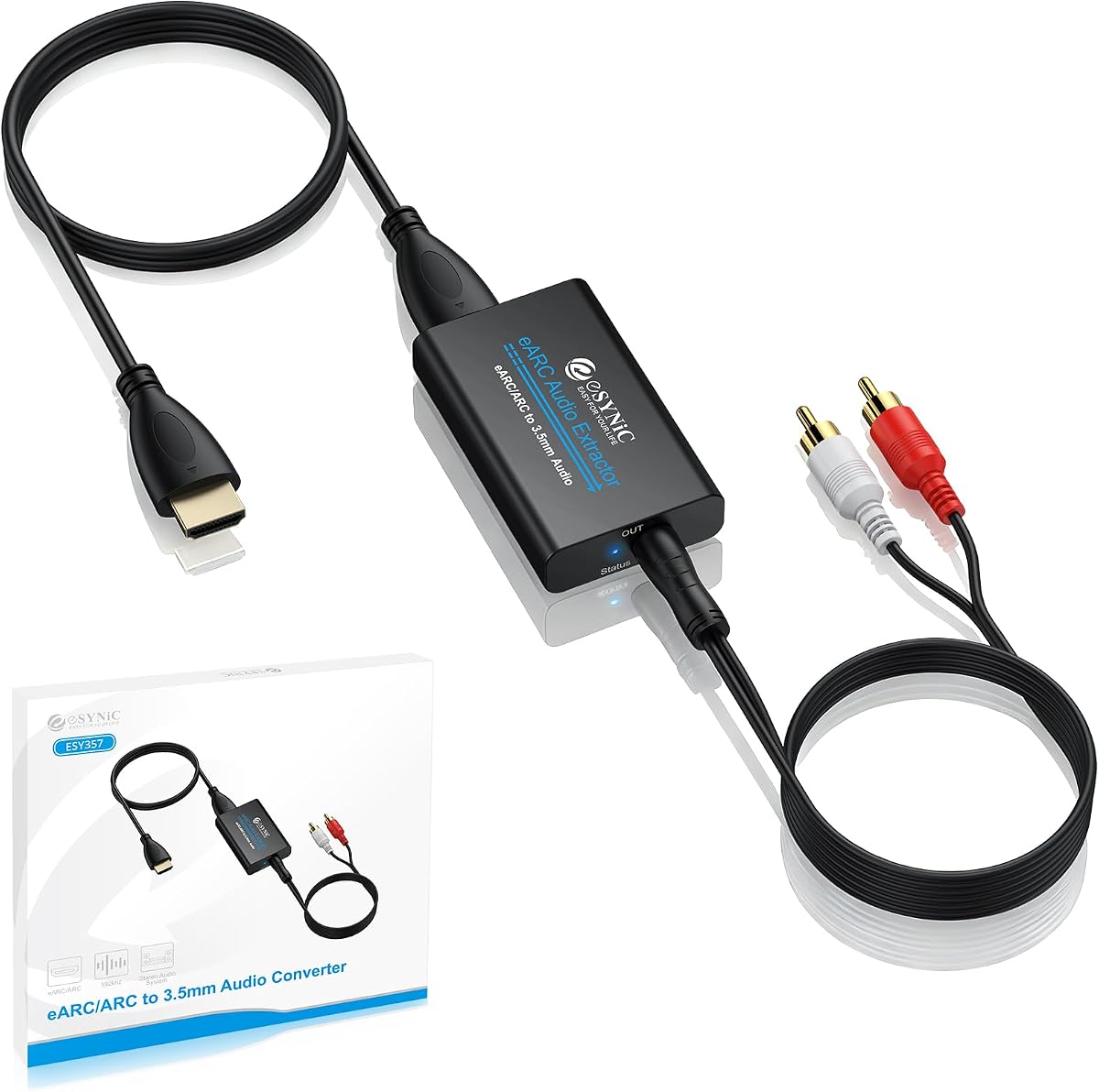
eSynic Professional 192KHZ
4.5Editor score
3.5mm AUX and L/R outputs
Supports PCM audio formats
Plug and play USB power
This expert guide compares the top ten Earc Audio Extractor models to help you find the perfect device for connecting your modern TV to legacy audio systems
Modern televisions often lack the versatile audio output options needed to connect to high-quality external sound systems. An Earc Audio Extractor solves this by pulling high-fidelity sound from your TV's HDMI ARC or eARC port and converting it for speakers or amplifiers.
We evaluated ten leading models based on audio quality, connectivity options, ease of setup, and overall reliability. Each device was scrutinized for its ability to handle high sampling rates and support various audio formats without introducing latency or distortion to your signal path.
Every product profile below highlights key specifications, pros, cons, and ideal use cases to streamline your decision-making process. Please note that availability and pricing can change frequently, so always verify current details before completing your purchase on the retailer site.
4.5Editor score

4.1Editor score

4.2Editor score
The following table provides a side-by-side comparison of all ten products examined in this guide. Use this overview to quickly identify which model offers the specific ports and features you need for your unique home theater configuration.


The VPFET HDMI eARC Audio Extractor stands out as a top-tier solution for users seeking high-fidelity audio extraction from modern TVs. Its ability to support sampling rates up to 192kHz ensures that you get crystal clear sound reproduction without losing any digital detail during the conversion process.
We may earn a commission when you buy through this link, at no additional cost to you.
This device offers exceptional versatility by providing simultaneous optical and coaxial outputs. This dual connectivity means you can connect multiple audio devices at once or simply choose the one that best suits your existing sound system setup. The independent status indicator makes it easy to confirm that the eARC connection is active and functioning correctly.
While the device excels in audio quality, users should be aware that it does not support CEC volume control. This means you will need to adjust the volume on your external amplifier or sound system directly rather than using your TV remote. This is a common limitation in this category but worth noting for seamless operation.
This extractor is ideal for audiophiles and home theater enthusiasts who want to upgrade older systems without replacing their main TV. It bridges the gap between modern eARC ports and legacy analog or digital inputs effectively, ensuring your favorite content sounds as intended regardless of your equipment age.
The support for 192kHz sampling rates ensures every audio detail is preserved during transmission to your external speakers.
Simultaneous optical and coaxial outputs allow you to connect multiple devices or choose your preferred audio interface easily.
We may earn a commission when you buy through this link, at no additional cost to you.
For budget-conscious shoppers who still demand high performance, the eSynic Professional model offers an impressive balance of cost and capability. With a high user rating, it has proven reliable for extracting clean audio signals from eARC ports to standard analog inputs like 3.5mm or RCA connectors.
We may earn a commission when you buy through this link, at no additional cost to you.
The device supports high sampling rates up to 192KHz, which is rare for devices in this price bracket. It effectively downmixes complex audio formats into high-quality stereo PCM output. This makes it perfect for connecting your TV to computer speakers, headphones, or a basic stereo amplifier without breaking the bank.
One limitation to note is that it does not support optical or coaxial digital outputs. If your sound system requires a digital connection rather than analog, this unit will not work for you. Additionally, it only supports PCM formats, meaning surround sound channels are downmixed to stereo.
This extractor is best suited for users who have simple audio setups and prioritize ease of use. It is an excellent choice for connecting headphones to the TV for night viewing or for upgrading a basic stereo system with modern eARC TV audio capabilities.
Despite its low cost, the device supports high sampling rates that ensure excellent sound clarity for analog outputs.
The focus on 3.5mm and RCA outputs keeps the setup simple for devices that do not require digital audio interfaces.
We may earn a commission when you buy through this link, at no additional cost to you.
The HDMI Audio Extractor 8K eARC is designed for enthusiasts who want to future-proof their home theater setup. It supports 8K video pass-through and advanced features like VRR and HDR, ensuring that your high-resolution video signals are not degraded while audio is being extracted for your sound system.
We may earn a commission when you buy through this link, at no additional cost to you.
Its triple operating mode capability offers significant flexibility. You can choose between pass mode for multi-channel support, stereo mode for universal compatibility, or SPDIF mode for dedicated surround sound. This adaptability makes it suitable for a wide range of devices, from gaming consoles to Blu-ray players.
While the higher price tag might be a consideration for casual users, the feature set justifies the cost for serious home theater builders. The ability to handle 4K at 120Hz and 8K at 60Hz means you will not outgrow this device as you upgrade your display or gaming hardware in the near future.
This is the ideal choice for those with premium setups who cannot compromise on video quality or audio format support. It serves as a comprehensive hub that manages high-speed video signals while delivering high-quality audio to your external speakers or receiver effectively.
Support for 8K and 4K 120Hz ensures your high-fidelity video signals pass through without any quality loss during audio extraction.
Multiple operating modes allow you to optimize the audio output based on your specific receiver and speaker configuration needs.
We may earn a commission when you buy through this link, at no additional cost to you.
The CAMWAY extractor distinguishes itself with a versatile array of outputs including Optical, RCA, and 3.5mm. This means you can connect a soundbar, a legacy amplifier, and headphones all at the same time without needing extra switches or splitters. It handles Dolby 5.1CH audio via optical while maintaining stereo on analog ports.
We may earn a commission when you buy through this link, at no additional cost to you.
This simultaneous output capability is particularly useful for households where different users might want to listen to audio through different devices. For example, you can listen through headphones while keeping the main speakers muted on the TV, all managed through this single compact unit effectively and efficiently.
One trade-off is the volume control behavior. While analog ports allow volume control via the TV remote when enabled, the optical output requires volume adjustment on the amplifier. This is a standard technical constraint but adds a slight layer of complexity to your setup routine initially.
If you need to connect multiple audio devices simultaneously, this is one of the most capable solutions available. It balances price and performance well, making it a strong contender for those who need flexibility in how they connect their audio gear to their modern television set.
Simultaneous outputs let you connect headphones, a soundbar, and speakers all at once for maximum flexibility in your home setup.
The optical output supports full 5.1 channel surround sound, ensuring you get immersive audio for movies and games.
We may earn a commission when you buy through this link, at no additional cost to you.
Tendak offers a robust extractor that supports a wide range of audio formats including PCM, AC3, DTS, and Dolby True HD. This makes it a solid choice for users who need to match specific audio formats to their external equipment. It supports high sampling rates up to 192KHz for detailed stereo sound.
We may earn a commission when you buy through this link, at no additional cost to you.
The device offers four different output modes, giving you flexibility in how you connect your devices. You can use HDMI, optical, RCA, or 3.5mm jacks depending on what your equipment has. This versatility ensures you can use it with most setups without needing extra adapters or converters for connection.
Users should note that simultaneous multi-channel audio output is not supported. This means you can output to HDMI and optical, or RCA, but not all at once in different formats. However, for most users, having multiple choice ports is sufficient to connect their primary audio system.
This extractor is well-suited for those upgrading legacy amplifiers that lack eARC. It provides a reliable bridge between your modern TV and older high-quality audio equipment, preserving sound quality while extending the life of your existing home theater components effectively.
Support for Dolby True HD and DTS ensures you can use almost any audio format from your streaming or gaming sources.
With 192KHz support, the device ensures high-fidelity audio transmission that captures fine details in music and dialogue.
We may earn a commission when you buy through this link, at no additional cost to you.
If your only goal is to connect your TV to an optical soundbar or speakers, this focused extractor is an excellent choice. It removes unnecessary coaxial or analog jacks that you might never use, reducing cable clutter on your entertainment console significantly. The dedicated optical design keeps things simple.
We may earn a commission when you buy through this link, at no additional cost to you.
The compact build fits easily into tight spaces next to your TV. It supports high-quality audio extraction and provides a clear status LED so you always know if it is receiving power and a signal. This transparency helps troubleshoot setup issues quickly without confusion.
The limitation here is that it does not support volume control through the TV remote via CEC. You will need to adjust the volume directly on your sound system. This is a common constraint with optical connections but is a fair trade-off for the simplified and affordable device design.
This model is perfect for minimalists who do not need extra inputs or outputs. It efficiently solves the problem of converting eARC to optical without adding complexity, making it a great value for upgrading old audio gear quickly and reliably today.
By focusing on a single optical output, this device saves space and reduces the cable mess often found with multiport units.
The LED status indicator confirms power and signal receipt instantly, helping you avoid setup errors during initial installation.
We may earn a commission when you buy through this link, at no additional cost to you.
This OREI converter is designed for simplicity and works well for basic stereo setups. It extracts PCM audio from the eARC port and converts it to analog signals for RCA or 3.5mm outputs. It is straightforward to set up and includes a physical power switch for easy on or off control.
We may earn a commission when you buy through this link, at no additional cost to you.
The device supports stereo audio up to 192kHz and 24-bit depth, ensuring your music and dialogue sound crisp. However, it is important to note that it does not support multi-channel surround sound. If you require 5.1 or higher, this model will not meet those needs.
Users looking for a cheap and reliable way to connect old speakers will find this effective. The inclusion of a power switch is a small but helpful feature that some competitors omit, giving you more control over the device when not in active use daily.
This unit is best for users who primarily listen to music or watch TV with simple speakers. It is not suitable for home theater enthusiasts needing surround sound but serves as a solid bridge for upgrading basic analog audio systems today.
The device focuses on delivering high-quality stereo audio for users who do not need complex surround sound formats.
An included power switch allows you to manually turn the unit off when it is not in use for convenience.
We may earn a commission when you buy through this link, at no additional cost to you.
This OREI model is built for advanced setups requiring high bandwidth. It supports 8K video pass-through and formats like DTS:X and Dolby True HD. It extracts full audio from your HDMI source and passes high-resolution video to your display, which is essential for modern gaming or movie systems.
We may earn a commission when you buy through this link, at no additional cost to you.
It is important to note that this unit is designed to work with AV Receivers with HDMI inputs, not soundbars. This makes it a specialized tool for enthusiasts who want to keep their audio routing strictly within their receiver chain for the best quality possible in a high-end setup.
The dual voltage power supply makes it easy to use internationally without needing extra adapters. This travel-friendly design adds value for users who might take their setup abroad. The support for VRR and ALLM ensures gaming performance is not compromised during extraction.
If you have a high-end home theater system, this extractor ensures your video and audio are transmitted with maximum fidelity. It is a premium choice for users who need to maintain 4K or 8K signal integrity while routing audio to a separate receiver system.
DTS:X and Dolby True HD support ensure that immersive audio formats are preserved when routing through your receiver.
The dual voltage power supply allows you to use the device in different countries without needing additional power converters.
We may earn a commission when you buy through this link, at no additional cost to you.
This OREI digital converter provides both Toslink and Coaxial outputs, giving you two ways to connect your digital sound system. It supports 5.1 channel surround sound via optical or coaxial, making it a great upgrade path for older home theater systems that lack modern eARC input options.
We may earn a commission when you buy through this link, at no additional cost to you.
The device works well with most modern TV setups, allowing you to extract audio from the eARC port and send it to an external speaker system. It handles PCM 5.1 and 2.0 audio efficiently. You will need to use a 2.1 cable for full eARC functionality with your TV.
Users should be aware that volume control via the TV remote is not supported on these digital ports. You must adjust the volume on the sound system itself. Also, it does not support Dolby AC3, so check your source content formats before buying to ensure compatibility.
For users wanting a straightforward digital bridge for their surround sound, this is a solid choice. It allows you to get 5.1 sound without buying new equipment, preserving your investment in existing amplifiers while using your latest television features effectively.
Having both Toslink and Coaxial outputs gives you flexibility to connect to a wider range of legacy digital audio equipment.
The ability to extract 5.1 surround sound ensures immersive audio is maintained even when connecting older receivers to new TVs.
We may earn a commission when you buy through this link, at no additional cost to you.
The J-Tech Digital 8K HDMI extractor is packed with advanced features like EDID management and HDCP 2.3 compliance. It is designed for complex setups where ensuring proper communication between your source, display, and audio system is critical. It supports 8K 60Hz video pass-through effectively.
We may earn a commission when you buy through this link, at no additional cost to you.
It offers optical, L/R, and HDMI audio outputs, giving you the option to route audio to your specific device type. The EDID DIP switches allow you to fine-tune how the device negotiates resolution and audio capabilities with your connected hardware, preventing handshake issues.
While the feature set is robust, the setup can be more complex than plug-and-play units. Users may need to adjust DIP switches to get the desired output behavior. However, this control is beneficial for advanced users who need to troubleshoot compatibility issues with specific hardware combinations.
This device is ideal for enthusiasts who need to manage HDMI signal paths precisely. It ensures your high-resolution video and high-quality audio reach their destinations without loss, making it a powerful tool for a sophisticated home media server or console setup.
DIP switches allow you to manually adjust signal negotiation to prevent compatibility issues with different devices.
Support for 8K video ensures that you can extract audio without downgrading your high-resolution video signal.
We may earn a commission when you buy through this link, at no additional cost to you.
Choosing the right extractor requires understanding your specific audio and video requirements. This guide breaks down the key factors you should consider before purchasing.
First determine whether your sound system requires digital optical coaxial or analog RCA and 3.5mm connections. Some extractors offer multiple output types simultaneously while others focus on one. Ensure the device supports the audio formats you need such as PCM or Dolby Digital.
Select an extractor with the correct output ports to match your existing equipment to avoid the need for additional converters.
If you need to pass video to your display while extracting audio check if the device supports your required resolution. Models vary from 1080p support to 4K 120Hz and even 8K. Ensure the extractor supports HDR and HDMI 2.1 if you have high-end gaming consoles or streaming devices.
Choose a device with video pass-through that matches your monitor or TV capabilities to prevent resolution downscaling.
Audio quality is determined by the supported sampling rates and bit depth. High-quality extractors support up to 192kHz 24-bit audio which preserves more detail in the sound. Lower-end models might be limited to 48kHz or only PCM stereo which could lose detail in surround content.
Prioritize extractors with high sampling rates if you are using high-fidelity speakers or an external DAC.
Consumer Electronics Control allows you to control volume using your TV remote. However many optical and coaxial extractors do not support this feature. Check product details carefully to see if CEC is supported so you do not have to change remotes every time you want to adjust sound.
Confirm volume control support based on whether you prefer using your TV remote or your external device remote.
Some extractors are bus-powered via the HDMI cable while others require an external USB power adapter. External power ensures stable signal transmission especially for high-bandwidth audio. Ensure you have a nearby USB port or outlet available if the device needs external power.
Opt for externally powered devices if you experience signal dropouts with passive bus-powered units.
If you need surround sound such as 5.1 or 7.1 verify that the extractor supports it on your desired output. Some devices only output stereo to analog ports while allowing multi-channel on digital outputs. This limits your options for connecting soundbars versus traditional receiver setups.
Verify multi-channel support on specific output ports to ensure your surround sound setup works as intended.
Many extractors come with included HDMI optical and power cables which can save you extra costs. Others may require you to purchase cables separately. Check what is included in the box to ensure you have everything needed for immediate setup without extra shopping.
Look for bundles that include high-quality cables to reduce your initial setup cost and complexity.
Ensure the device is compatible with your TV model and source devices. Some extractors only work with TVs that have specific ARC or eARC ports. Others might have limitations with certain consoles or streaming sticks. Review the compatibility notes to avoid return hassles.
Check compatibility lists to confirm the extractor will work with your specific TV and media devices before buying.
Start by connecting the HDMI cable from your TV to the HDMI ARC or eARC port on the extractor. Ensure the cable is securely plugged in to avoid loose connections that could cause signal loss or intermittent audio dropouts during playback.
Connect the desired audio output cable such as optical or RCA to the extractor and then to your sound system. Power on the extractor using the included adapter or USB cable if required by the specific model you are using.
Navigate to your TV settings menu to enable the ARC or eARC audio output option. You may need to set the audio output to PCM or Bitstream depending on your external device requirements to ensure the audio is properly formatted for extraction.
ARC is the standard audio return channel while eARC offers higher bandwidth and supports uncompressed audio formats. Most extractors work with both but eARC specific models are better for high-quality multi-channel audio like Dolby True HD.
No only one specific HDMI port on most TVs is labeled ARC or eARC. You must use this specific port for audio extraction to work. Check your TV manual to find the correct port if it is not clearly labeled.
Check that the device is powered on and connected to the correct HDMI port. Ensure your TV is set to output audio via ARC or eARC and that the correct audio format is selected in the TV settings menu.
If your soundbar has HDMI ARC input you might not need an extractor. However if it has optical or coaxial inputs you will need an extractor to convert the HDMI signal to those formats for connection.
Yes using a high-speed HDMI cable that supports ARC is recommended. Standard HDMI cables might work but certified cables ensure better signal stability especially for high-resolution video pass-through and audio extraction.
Yes extractors generally work with consoles if they are connected via the TV. Ensure the TV supports ARC or eARC and the extractor supports the video resolution your console outputs to avoid any video signal issues.
This depends on the extractor and the output type. Optical and coaxial outputs often do not support CEC volume control so you must adjust volume on the sound system itself.
Many modern extractors support HDMI 2.1 features like 4K 120Hz but check the specific model details. Basic extractors may be limited to 4K 60Hz or lower resolutions for video pass-through.
We have reviewed ten top extractors ranging from budget-friendly analog options to premium digital solutions. Each model offers unique benefits depending on your audio setup and connectivity needs.
Prioritize features like high sampling rates and multiple output ports if you have a complex home theater system. For simple stereo needs budget models with basic outputs are often sufficient and cost-effective.
Remember to verify your TV compatibility before making your purchase to ensure smooth integration with your existing hardware and avoid return issues later.